THE
DEVELOPMENT BRANCH
|
I. Putting
Down Roots (1 9 8 4 – 1 9 8 9) |
Each of the three branches can be traced to
activities or events in the first years of PS’s existence and though closely inter-related
the branches can nevertheless be tracked through the years as they each took a
different direction, not so much geographically initially, since they were
mostly in the same areas of operation, but in the issues they tackled and the
approach adopted.
WEP PROGRAM
|
Meeting
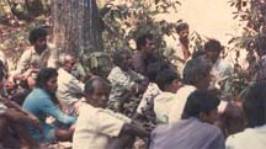
of forest dwellers against eviction at Cotigaon |
The first development
activities were in Bandora village in the form of an income generation program for
women. This was a very limited project in one village with a very small group
of 20 women, the Women’s Employment Program (WEP) with a very small budget. It
was intended as an entry-level activity, including both education and an
economic program for the group of women involved. The goal of the economic
program was to generate income generation opportunities out of locally
available materials for groups of women working together. This included making
of brooms and leaf plates as well as foodstuff like papads and jackfruit
wafers.
While the economic programme
did achieve some measure of success, the real benefit to PS from this initial
phase was the learning from its failures, that helped it to design and
implement later activities. The shortcoming of this initial were recognized as-
· A lack of understanding by
the participants regarding the overall goal and development approach of the
Society.
· A “welfare beneficiary”
attitude generated in the women.
· PS was perceived as an employer,
even if benign in its attitude
· Project impact was reduced
because of the resistance of the men who were suspicious of the project’s
intentions.
· The project area and scope
was limited thus reducing the impact.
What PS learnt form this first phase of work
was that poverty was not merely a lack of money but of the capacity to make
decisions that would determine their own future Therefore more comprehensive
programs were needed, which included the participation of the men and which
seriously impacted the family livelihood.
The development activities
were therefore re-designed in scope and coverage in the next phase, the first
stage of the Integrated Rural Development (IRD) program.
THE IRD PROGRAMME, STAGE 1: 1987-89
The PS IRDP program was
designed and implemented in collaboration with Gandhi Peace Centre, Hyderabad
with support from EZE. The project objectives were threefold:
i.
Livelihood
enhancement of poor and marginal farmers through setting up service centres
(Agro Centres) to provide services in agriculture and animal husbandry. The
objectives were to increase productivity in these sectors as well as provide
income-generating opportunities, both on-farm and off farm for these families.
ii.
Mobilizing
the community and creating an overall awareness towards social reconstruction.
This was through activities in the health and education sectors.
iii.
Women’s
Development through training for economic skills and opportunities for
employment.
The project was implemented
in three of the original five villages, with Agro Centres opened in Deusu
Korgaon and in Cotigaon, while the WEP activities were continued in Bandora.
The activities in this phase continued until
1989. The Agro-centres were very popular and the performance, as measured by
the relevance and quality of the services provided by the centres, good. The
agro-based production activities of the WEP program in Bandora went through
several ups and downs. The major constraint was the marketing of products,
which in turn was affected by problems of quality control. The jackfruit wafer
proved the most popular and even achieved some degree of brand recognition in
the area. But the highlight of this branch in these years was the Cotigaon
experience.
THE COTIGAON EXPERIENCE
PS was working in 5 villages in the area. The
area was remote and relatively under-developed even as compared to the other
areas in Goa. The inhabitants were almost entirely adivasis. The entry points
were the house-to-house survey in 1985 and then the project work in 1986. The
Agro-centre functioned well and there was also a good educational program, both
for adults and children. But the major achievement and impact was in the area
of social organization, which was concretised in the formation of a community
organization, the Vanvasi Sanghatan.
THE VANVASI SANGATHAN
The major problem facing the
local population was the government plan to set up a Nature Sanctuary covering
the land of all five villages and the relocation of the population in another
area. The survey and the project services proved to be a good base for a more
comprehensive socio-economic action program, and the Vanvasi Sanghatan covering
all 5 villages was formed to fight for their rights and principally to resist
eviction form their traditional lands. In spite of strong opposition from
political and government circles, the people stood firm against force and later
to resist “bribes” in the form of government handouts and benefits in an
attempt to break the people’s unity.
The women formed the
backbone of the movement and it was because of them that the men were able to
stand their ground along with them. And in the end the people were to wrest
significant concessions from the government with four out of the five villages
spared from eviction.
But there was another gain
for PS from this activity, namely that environmental protection while important
and even vital, especially in a state like Goa, must never negatively effect
the rights of the local populations, especially the poorer sections. This provided the inspiration for PS’ later
involvement in a number of environment-based campaigns in Goa and indeed the
country, in collaboration with other NGOs and peoples organizations. PS always
and everywhere championed the cause of the local communities while also
ensuring their active participation in the movements and campaigns. This was
particularly true for the key Ecological activity of these years, The Save
the Western Ghat Movement that is the trunk or main element in the
Ecological Branch of this period.
1989 - 1997
IRDP
PHASE 2
While environmental
campaigns and institution building held centre-stage for PS during this period,
the development work also continued and progressed. This was through the 2nd
Phase of the IRDP project with Gandhi Peace Centre, Hyderabad and EZE Bonn,
Germany. The work continued with expanded scope of activities and an increased
geographical range. The project objectives were also modified based on the
learning, both of the earlier development work as well as the experience of
organizing communities around issues in the campaigns. The new approach was:
·
Agricultural
development was seen not only in the context of economic self-reliance but also
in the context of ecological balance. As a result there was an increased
emphasis on sustainable agricultural systems and in particular on organic
farming. PS took it as challenge and started various experiment on organic
farming in its campus.
·
The
social reconstruction goal was possible only if there is a cadre of committed
persons in the community, committed not just to short-term project activities
but to broad based civil society associations through setting up autonomous
institutions with strong and committed leadership. This insight would take full
shape in and through the Swaraj Movement.
·
Women’s.
Self-reliance is not just an output of the project activities but must be an
integral aspect in the very process. As a result, the practice of free services
was discouraged and eventually discontinued and participants were motivated to
pay fees for the services accessed.
There were 7 village centres of work.
Pedne was one of the most active areas, where besides agriculture related
activity, there was a strong emphasis on women’s groups accessing the DWCRA
scheme. In all there were 7 such groups, which eventually achieved autonomous
status. Other centres were Cotigaon, later shifted to Paigini, Madkai and
Bandora.
The main sets of activities
were in three sectors-
Agro-Centres
These centres were the base
for a variety of services and training programs. These included
· Power tiller/sprayer
services
· Desilting of tanks
· Farming systems inputs
· Land improvement
· Organic farming training and
demonstration
· Afforestation
· Biogas system
Livelihood Training Programs
These included
· Farmers camps
· Fisherman’s Training program
· Training in Production of
foodstuffs for women entrepreneurs
· Vocational Training for
Women specially in tailoring,
Women’s Economic Program
·
Production
centres for foodstuffs
·
Production
training Program for independent entrepreneurship
·
Vocational
Training
·
Handicrafts
·
Marketing
Assistance.
THE PS CAMPUS
|
|
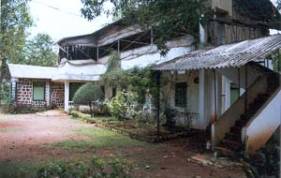
During this period PS made efforts to get land from local Communidad in
Bandora village to develop a campus for its own activities own. However, these
attempts were in vain. Thereafter, in 1989 succeeded in buying a 4-½ acre farm
in Madkai village, a short distance away from Bandora. The main building was
built within a year and PS shifted it office from Bandora to this new own
campus. The chosen village met all the criteria set by PS, which primarily
wanted to set up its base in a remote village with a population of poor people,
and marginalized farmers, where the campus would became the hub of experiment
towards self-reliant villages. Over the years, a new campus gradually took
shape. The campus was designed to merge harmoniously with the environment with low
buildings and not a single tree was cut down for buildings. The campus now
provided a convenient site for variety of trainings activities and successfully
engaged in natural farming.
Now the Campus has following
infrastructures and facilities.
Besides above the campus is unique site of experiment on natural / farming which is full of Hundreds of tree, shrubs and creepers. For detail please refer chapter on Organic Farming.
DOCUMENTATION CENTRE 1992
Having the campus infrastructure made it possible for PS to take up another role – that of documentation. It begins with keeping paper clipping on and about some 110 subjects and events. PS also conducted or promoted a number of studies on various topics and issues, most of them related to the environment and Biodiversity in Goa and about the Western Ghats.
The Studies were
the outcome of the activities and engagements of PS and also provided direction
and impetus to fresh initiatives. One example of this was the Bio-diversity
Workshop organized in 1996 and seminar on medicinal plants of Goa.
Later in 1998, as PS changed its basic strategy and put greater emphasis
on national level work, the it would be readily available for consultation and
everyday use. Documentation Centre material was handed over to the library of
Goa Union of Journalists, Panaji.
|
YEAR OF STUDY |
SUBJECT OF STUDY
|
NAME OF RESEARCHER / DOCUMENTER |
|
1993 |
Earthworm Ecology In The Premises of Peaceful Society |
Mr. Kenneth Rodrigues |
|
|
The Oil Palm: Farm Failure or Fabulous Future? |
Mr. Bonnie A Menezes |
|
1994 |
Study of Forest Management by People Western Ghats |
Mr. Pandurang Hegde |
|
1995 |
Study of Proposed Golf-Course in Goa |
Mr. Bonnie A Menezes |
|
|
Goa’s Coastal Ecosystem Under Attack |
Mr. Bonnie A Menezes |
|
|
Aquatic Pollution in Ponda Taluka |
Ms. Asha S Nandurmath Dr. Nandkumar kamat |
|
|
Fungal Biodiversity at Peaceful Society Campus |
Dr. Nandkumar Kamat |
|
|
Ecological & Economic Aspects of Alluvial Sand Mining from
Terekhol & Colvale Rivers |
Dr. Nandkumar Kamat Mr. Vishwas Kesar Mr. Vithoba Desai Ms. Kirti Mandrekar |
|
|
Ecological & Economic Aspects of Shellfish Exploitation from
Colvale Estuarine Ecosystem |
Dr. Nandkumar Kamat Mr. Nilesh Vernekar Ms. Shilpa Narvekar |
|
1998 |
Awakening of A Village: The Story of the Struggle of the People of
Kottukal for Survival |
Mr. P.M. Dev |
|
1998 - 1999 |
A Report on Dang Communal Outrage |
Mr. Anwar Rajan, Mr. Ramesh Gaus, Mr. Shekhar Sonalkar and Ms. Vasanthi Dighe |
|
1999 – 2000 |
Cultivation and Study of Medicinal Plants at Peaceful Society Campus |
Ms. Gaytri Pawar Ms. Pratibha Naik and Ms. Sujata Menase |
<< >>
 INCOME GENERATION